When attaching a roof spoiler in the premium segment, an automobile manufacturer encountered a requirement that quickly pushed a standard solution to its limits:
A self-adhesive molded part had to ensure high holding forces, withstand extreme temperatures, and fit perfectly into the installation space—without additional process steps at Tier 1.
This made it clear that it was not only the material itself, but above all the pull tab that determined the success of the series.
Process-related key requirement:
A strong but interference-free tab
The pull tab must not hinder assembly at any point – even though it is crucial for the final fixation.
In addition, it is pulled off in the opposite direction to the adhesive surface. This movement generates strong tensile and
peeling forces that a conventional tab cannot reliably withstand. A seemingly small function – with great process relevance.
Customer process
To ensure smooth installation, it had to be long enough and securely fixed in place, without sticking out or getting caught, and without requiring any additional handling.
A conventional pull tab design or a pull tab that was glued on later would have been disruptive and prone to errors.
A conventional tab design could have gotten stuck or come loose during the first step of the process, directly impacting cycle time and scrap rates. At the same time, the tab had to function reliably under high tensile forces in the opposite direction during the OEM process.
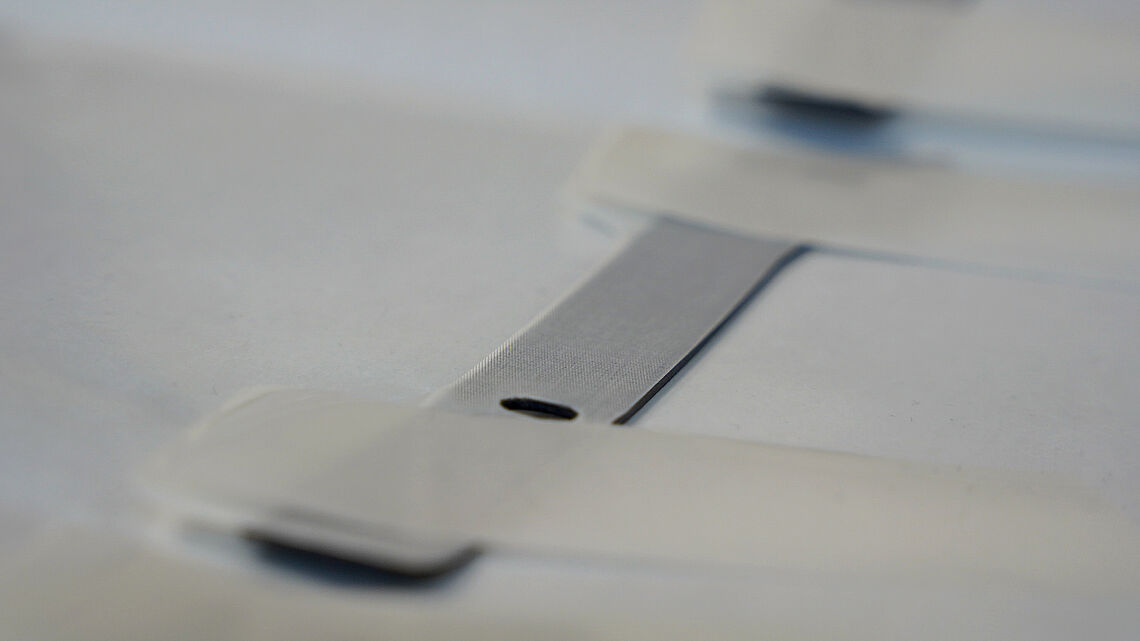
Our solution: a pre-folded tab fixed in a process-neutral manner that only performs its function at the decisive moment.
After punching, the tab is precisely pre-folded and securely fixed to the molded part via a defined adhesive surface. This ensures that it remains completely undisturbed during the first assembly steps – and can be released in a controlled manner during final removal.
To reliably absorb the strong pull-off movement against the adhesive direction, the tab was additionally reinforced with a fabric tape. This ensures that the forces generated are cleanly transferred into the material – even with tight tolerances and demanding component geometries.
The result: error-free assembly, reliable final fixation, stable series production process.
Additional process optimization:
narrower rolls for greater efficiency
Further potential for optimization became apparent during the course of the project: the rolls were to be hung side by side for assembly. Due to the production of the handling tabs from liner excess, the roll was very wide, but the molded part on it was no longer, as the tabs were subsequently folded and the overall molded part width was reduced.
This meant that only a few rollers could be hung next to each other. They had to be replaced more frequently, interrupting the process.
Our solution:
By combining a pre-folded, reinforced flap with optimized roller geometry, we achieved the following:
The solution is stable, precise, and easy to install—exactly what the vehicle line needs.
Complex requirements such as these demonstrate why a specialized converter is much more than just a supplier of molded parts. The decisive factor is a manufacturer-independent selection of materials, in which adhesive tapes, liners, and reinforcements are combined precisely according to their function. At the same time, good engineering does not start with the product, but with the process: installation space, peel angle, stresses, and handling are considered from the outset – not just afterwards.
The result is solutions that function reliably in everyday series production: stable, reproducible, and easy to install. This results not simply in molded parts, but in process-optimized series products that make a noticeable difference for the customer.
No matter how far along you are in your project:
We support you and take the work off your hands: in partnership, manufacturer-independent, flexible, and fast.