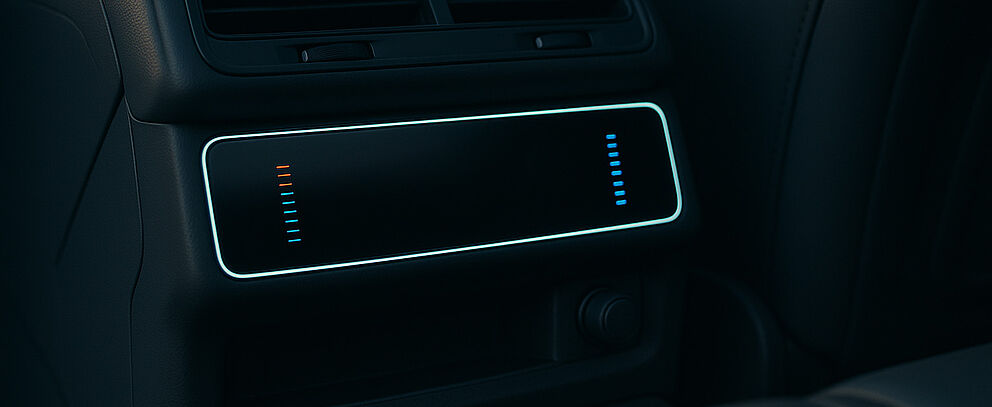
A glass cover had to be bonded precisely and permanently to a printed circuit board—tightly, partially opaque, and reliably. However, the liner adhered too strongly, the molded parts slipped, and the positioning pins stuck to the adhesive.
INNO TAPE developed a solution with a split removable liner, inner liner protrusions for clean placement, and additional positioning aids for precise assembly.
A supplier of climate control systems faced a complex challenge: the glass cover of a control device had to be bonded to a circuit board over its entire surface, permanently and with a flawless appearance—without visible inclusions, without misalignment, and without compromising the functionality of the overall system. The bond had to be not only mechanically stable, but also visually appealing and durable over the long term.
Challenges
Objective
The company was looking for a full-surface, durable, and visually clean bond between the glass cover and the circuit board that would not only ensure high holding forces but also reliably meet additional functional requirements. The bond had to be mechanically resilient, remain permanently stable, and show no weaknesses even under demanding environmental conditions.
In addition, the solution had to be cream-resistant, light-tight, and completely sealed in order to reliably protect sensitive components from external influences. Neither moisture, dust, nor chemical effects were allowed to impair its function. At the same time, a uniform, bubble-free appearance was required, as visual quality also played a central role.
The challenge was therefore to develop an adhesive solution that combined mechanical stability, protective function, and aesthetic requirements in a single, process-reliable, integrable system.

Together with the customer, we developed a solution that is impressive in terms of both materials and processes.
Material selection
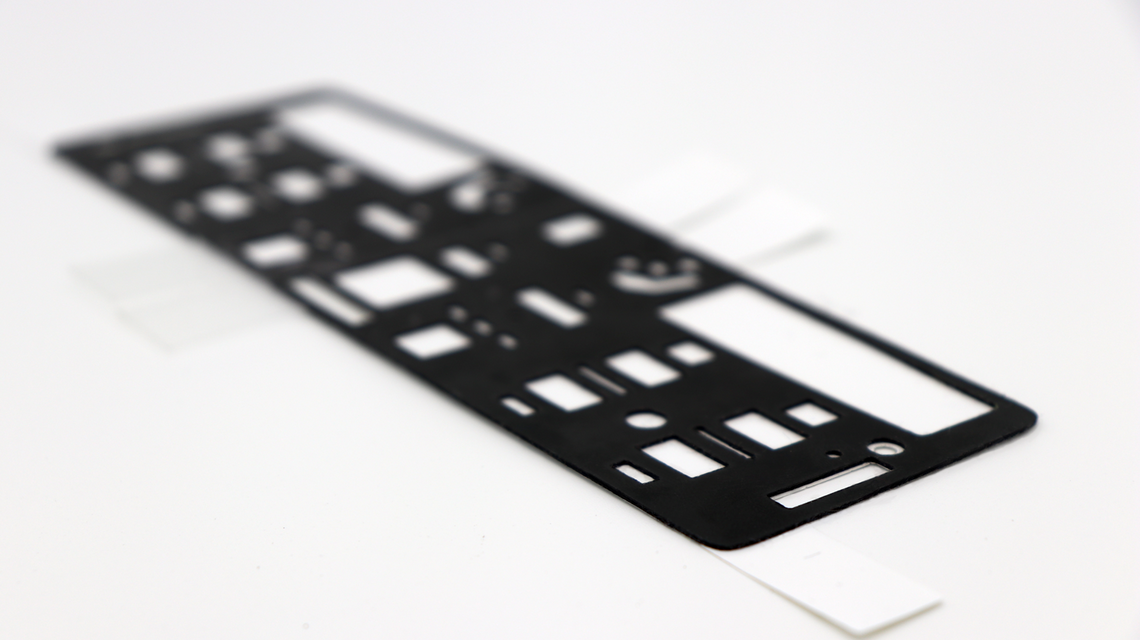
The tape was selected in an optimal thickness to ensure full-surface adhesion and complete sealing. The black design also gives the material a light-blocking function—especially in narrow bridge areas and between internal recesses.
Process optimization
The ideal design for the molded part was developed in several test runs. The tape was given several grip tabs and integrated positioning aids to enable easy and secure installation.
The liner was designed to be split so that the tape can be exposed section by section, keeping the molded part stable during processing and preventing it from slipping. A new liner with lower adhesion also ensures controlled, even removal.
Inner liner protrusions were integrated to prevent the positioning pins of the mounting device from coming into contact with the adhesive edge.
With almost 20 years of experience in adhesive tape converting for the automotive industry, we combine technical expertise with process understanding. We think beyond adhesive tape—we think about optimal assembly. From prototypes to series production, we develop solutions that work: technically, economically, and reliably.
No matter how far along you are in your project:
We support you and take the work off your hands: as a partner, manufacturer-independent, flexible, and fast.