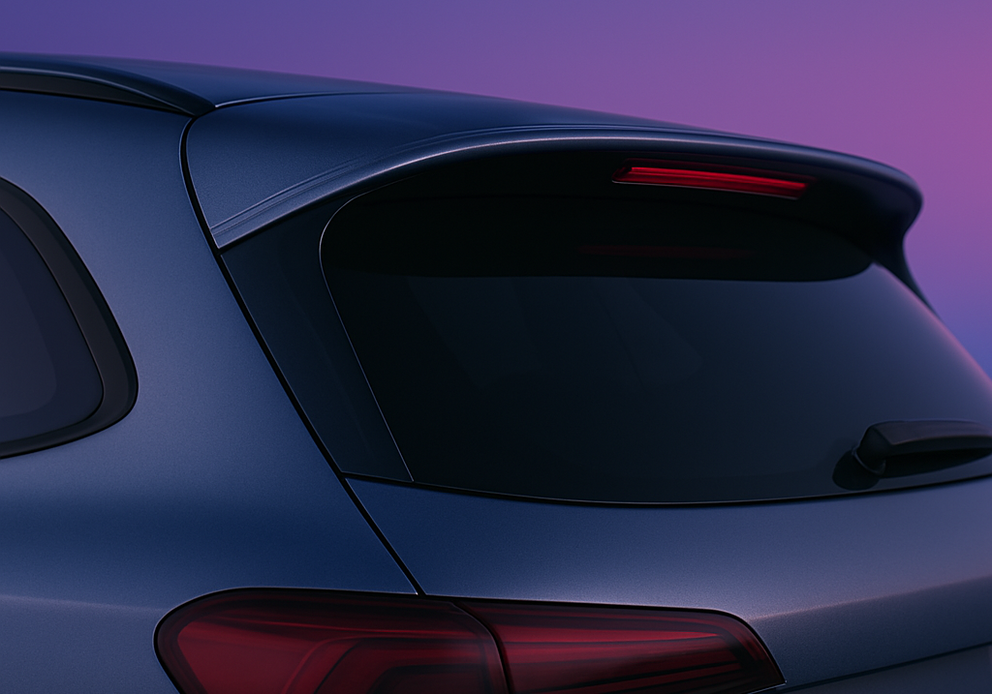
A supplier was faced with the task of applying protective film to four series of rear spoilers that it produces for a premium car manufacturer – precisely, reliably, and in large quantities. We have been the customer's partner for adhesive tapes and protective films for many years.
In the course of the inquiry, the question arose: Can we also provide a solution for semi-automated application in addition to the protective film? Our answer: Yes – together with an experienced fixture manufacturer.
The geometry of the component was complex: the protective film could not simply be laid out in two dimensions, but had to be precisely adapted to the 3D contours. To ensure that it would later fit without tension, adhere cleanly, and could be applied quickly during the process, the following was required:
1. Analysis & database
The customer provided us with the 3D data sets for the spoiler components. Based on these models, we developed the optimized 3D development of the protective film—including positioning holes and perforations for the subsequent process steps.
2. Development of the film geometry
The protective film had to fit neatly despite the component geometry. Due to the complex surface development, we ensured that:
- The film was not torn during the subsequent processing steps
3. Design of the application device
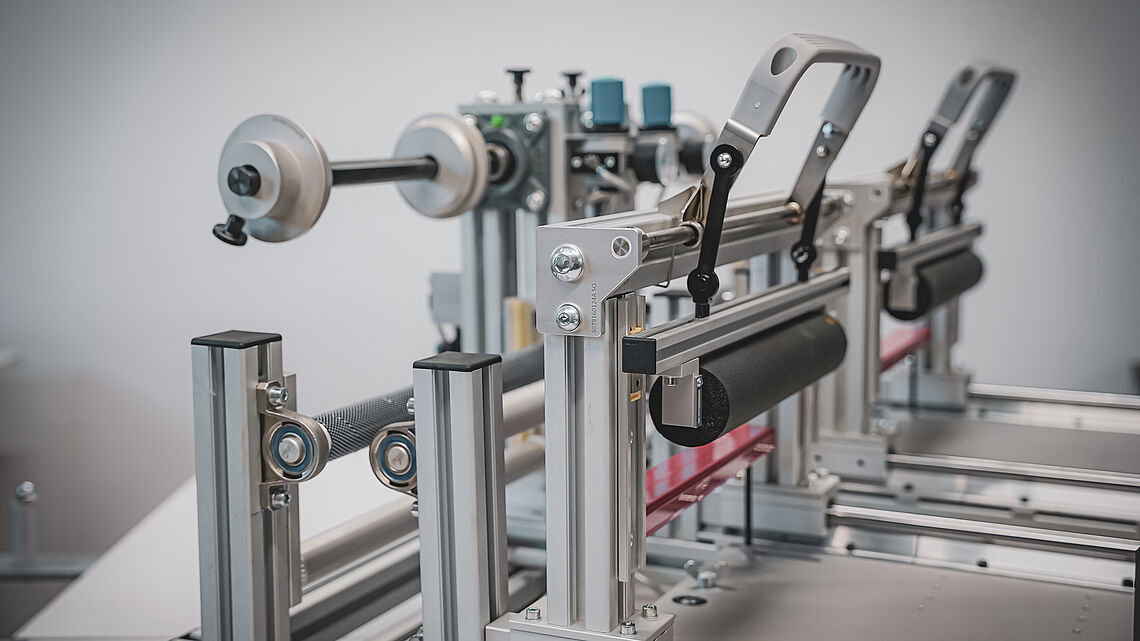
Together with the device manufacturer, we developed a semi-automated system with a uniform base frame for all four series.
Only the component holder varies. This saves costs and shortens design times.
1. Inserting the component
The spoiler component is transferred directly from the injection molding production line to the application system via a conveyor belt and inserted into the device.
2. Positioning and tensioning the protective film
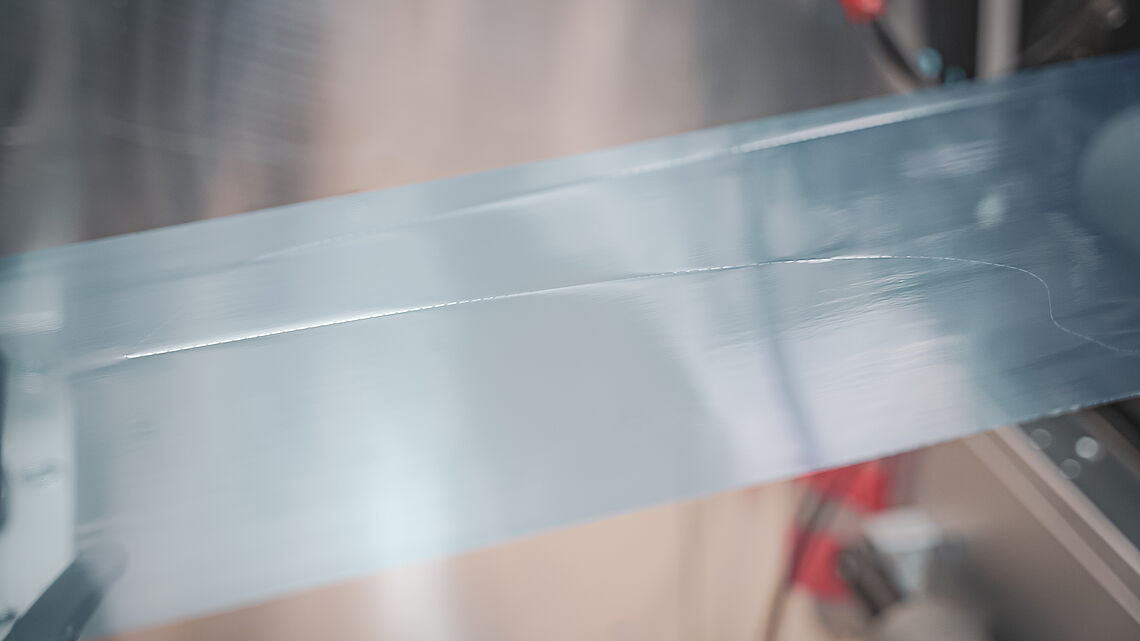
The film is pulled over the component. Integrated positioning holes ensure correct tension and precise alignment.
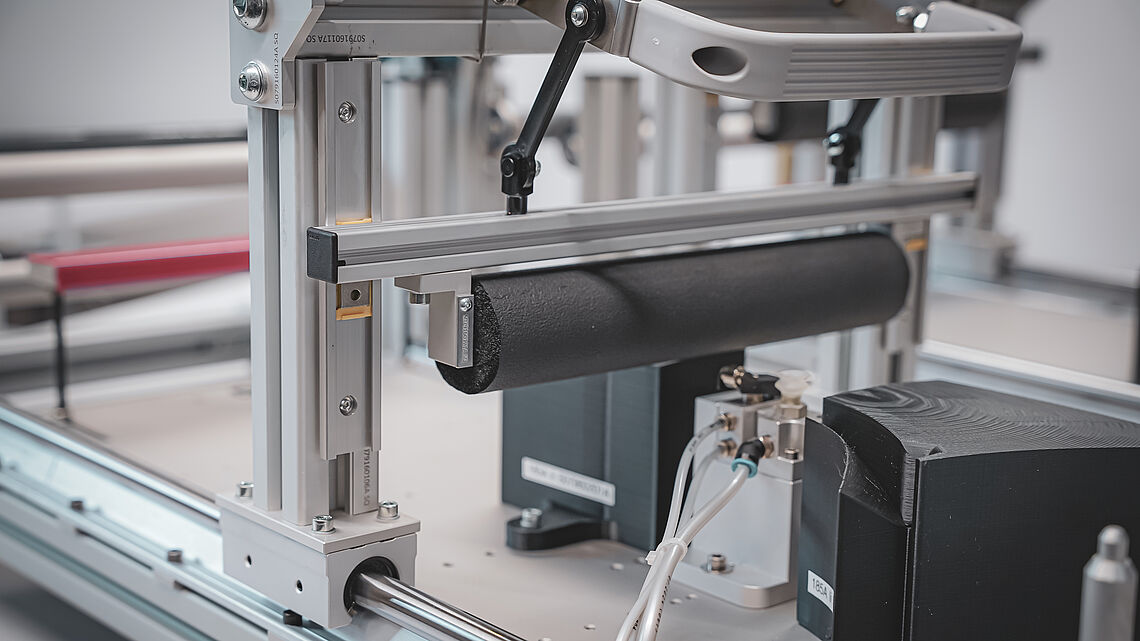
3. Semi-automated pressure application
A pressure roller integrated into the system applies the film evenly over most of the surface.
4. Separating the first surface
A defined perforation allows the remaining film grid to be quickly separated.
5. Manual side application
The film that is now still protruding can be applied by hand so that all areas are covered with protective film.

With almost 20 years of experience in adhesive tape converting for the automotive industry, we combine technical expertise with process understanding. We think beyond adhesive tape—we think about optimal assembly. From prototypes to series production, we develop solutions that work: technically, economically, and reliably.
No matter how far along you are in your project:
We support you and take the work off your hands: as a partner, manufacturer-independent, flexible, and fast.