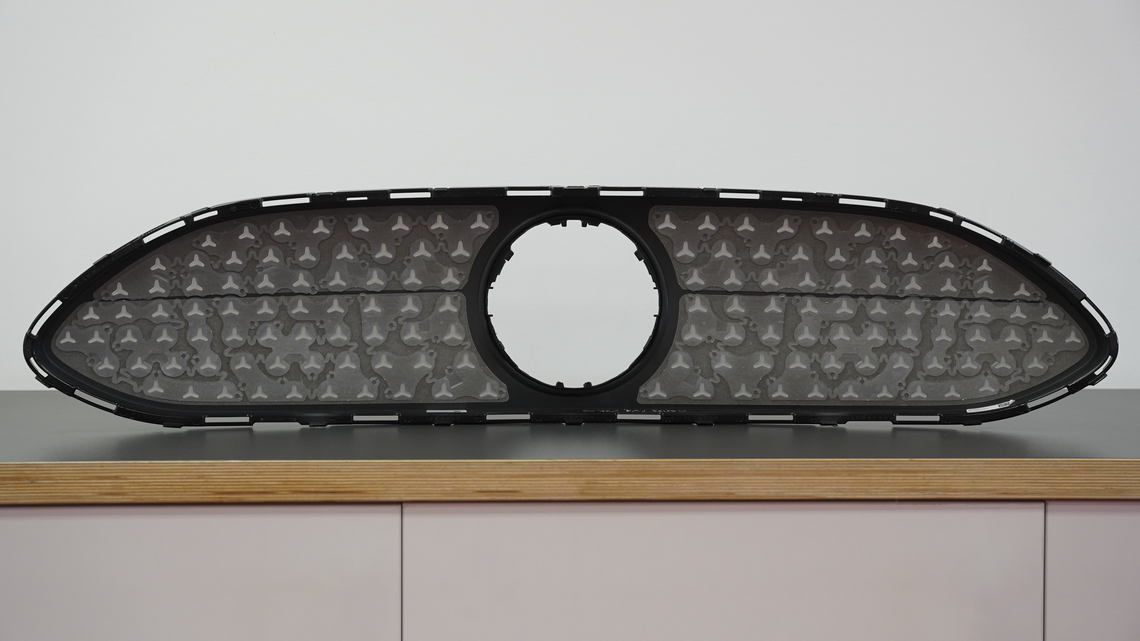
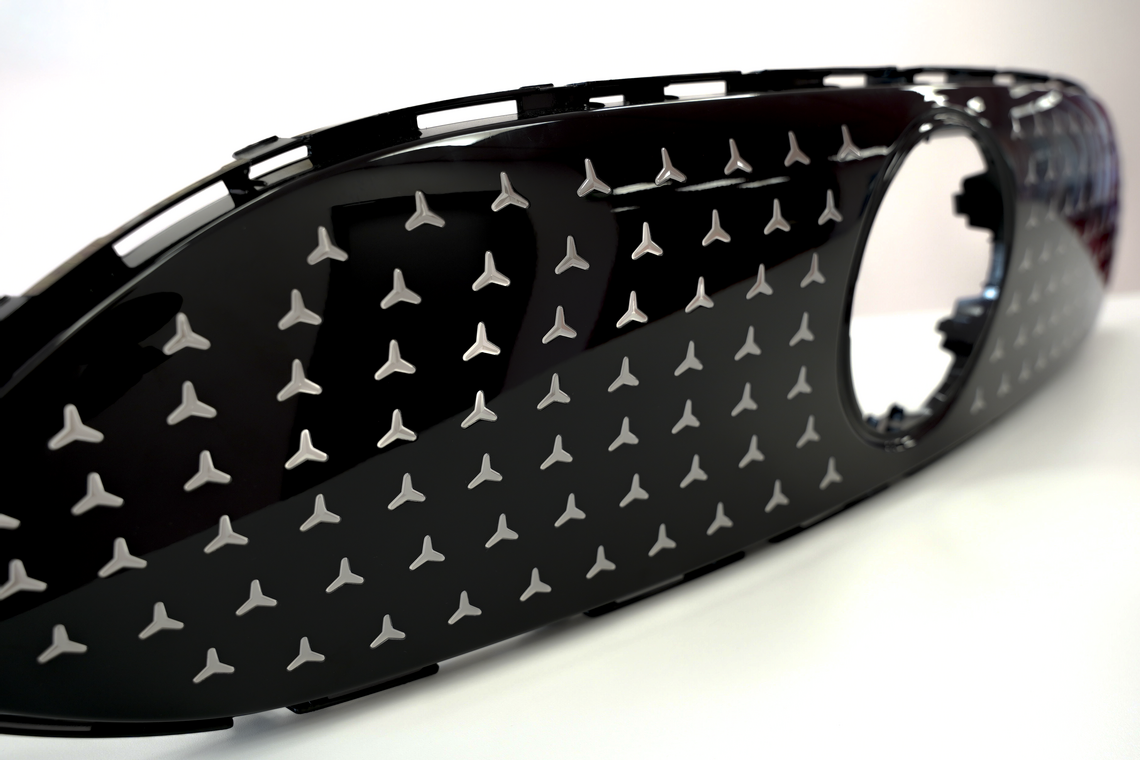
A premium manufacturer planned to introduce an illuminated radiator grille—a component that places the highest demands on appearance, tightness, and material quality. We were commissioned to develop a self-adhesive molded part that would ensure the fixation and sealing between the cover and the components behind it.
Initially, the plan was to leave the illuminated areas blank and apply the adhesive tape only to the existing surfaces of the cover. However, this approach proved difficult in practice: positioning was very time-consuming, repeatedly led to inaccuracies – and thus to uneven sealing and rejects.
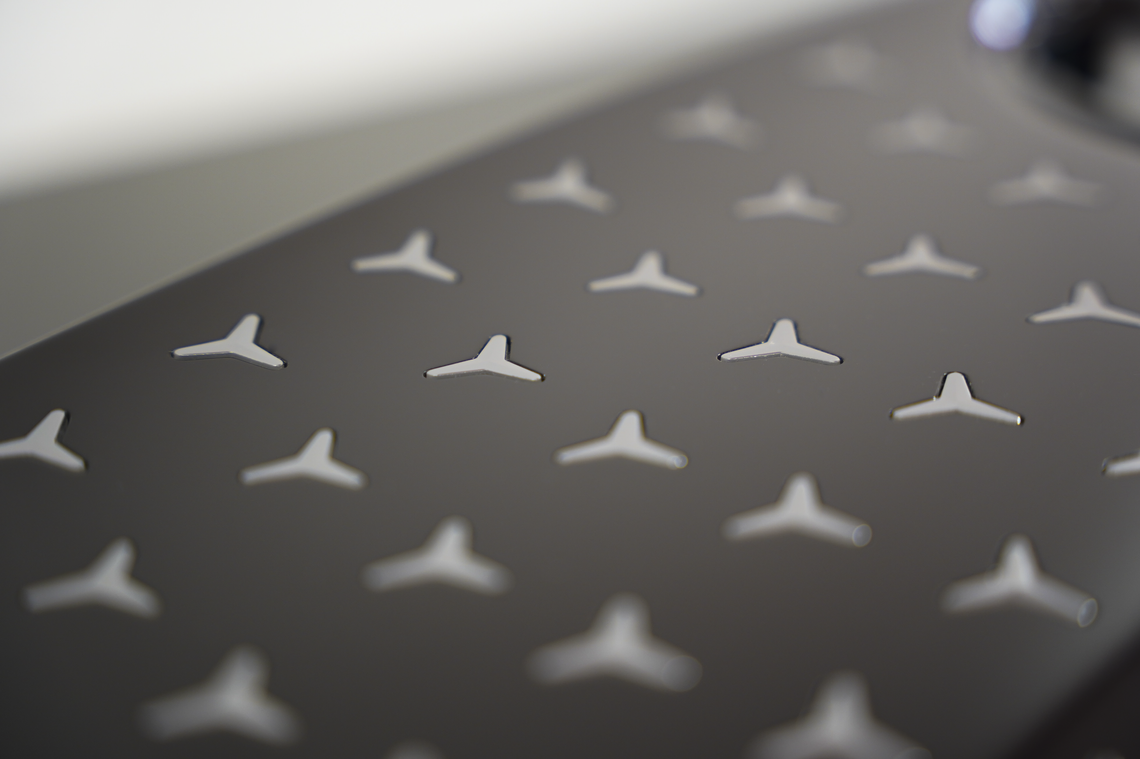
To simplify the process, a new concept was developed: a full-surface adhesive tape molded part that was first glued to an impermeable cover and then punched out together with the cover to expose the areas to be illuminated later.

Objective
The goal was to develop a self-adhesive molded part that securely fixes the illuminated radiator grille in place and reliably seals it—while also delivering the highest optical quality and eliminating rejects due to error-prone positioning.
Challenge
The acrylic foam adhesive tape specified by the customer left residues on the punching blades due to its adhesive core, which necessitated regular cleaning intervals. In addition, the plastic punching degree and material tension at the edges caused slight lifting, which prevented complete wetting and thus impaired the desired sealing effect. The problem was exacerbated by the challenging component geometry and the pressure plates of the application device, which made it difficult to form the tape evenly. Since it was not possible to adapt the machine for economic reasons, the material had to be optimized.
Together with the material manufacturer, we developed a new solution based on PE foam. The material is softer and more flexible than the acrylic foam used previously and adapts better to the curved contour. This evens out any unevenness and ensures that the surface is evenly wetted. Since the PE foam only has adhesive layers on the top and bottom, the knives remain clean during punching and the cleaning cycle is significantly extended. In addition, the liner design has been optimized: a tab made from excess liner material allows the liner to be removed from both sides starting from the middle – quickly, ergonomically, and reliably.
The new molded part ensures uniform wetting, stable sealing, and clean punched edges—without changing the system design. The production process has become noticeably more stable and requires less maintenance.
The acrylic foam originally used remains a high-performance material with high adhesive strength. However, PE foam was the better choice for this application.
With almost 20 years of experience in adhesive tape converting for the automotive industry, we combine technical expertise with process understanding. We think beyond adhesive tape—we think about optimal assembly. From prototypes to series production, we develop solutions that work: technically, economically, and reliably.
No matter how far along you are in your project:
we support you and take the work off your hands: in partnership, manufacturer-independent, flexible, and fast.